BETA Technological Center opens new avenues for collaboration with China during its first mission to Chengdu
On 20 and 21 October, the delegation visited six Chinese institutions to identify scientific complementarities and explore opportunities for cooperation and joint projects
[addtoany]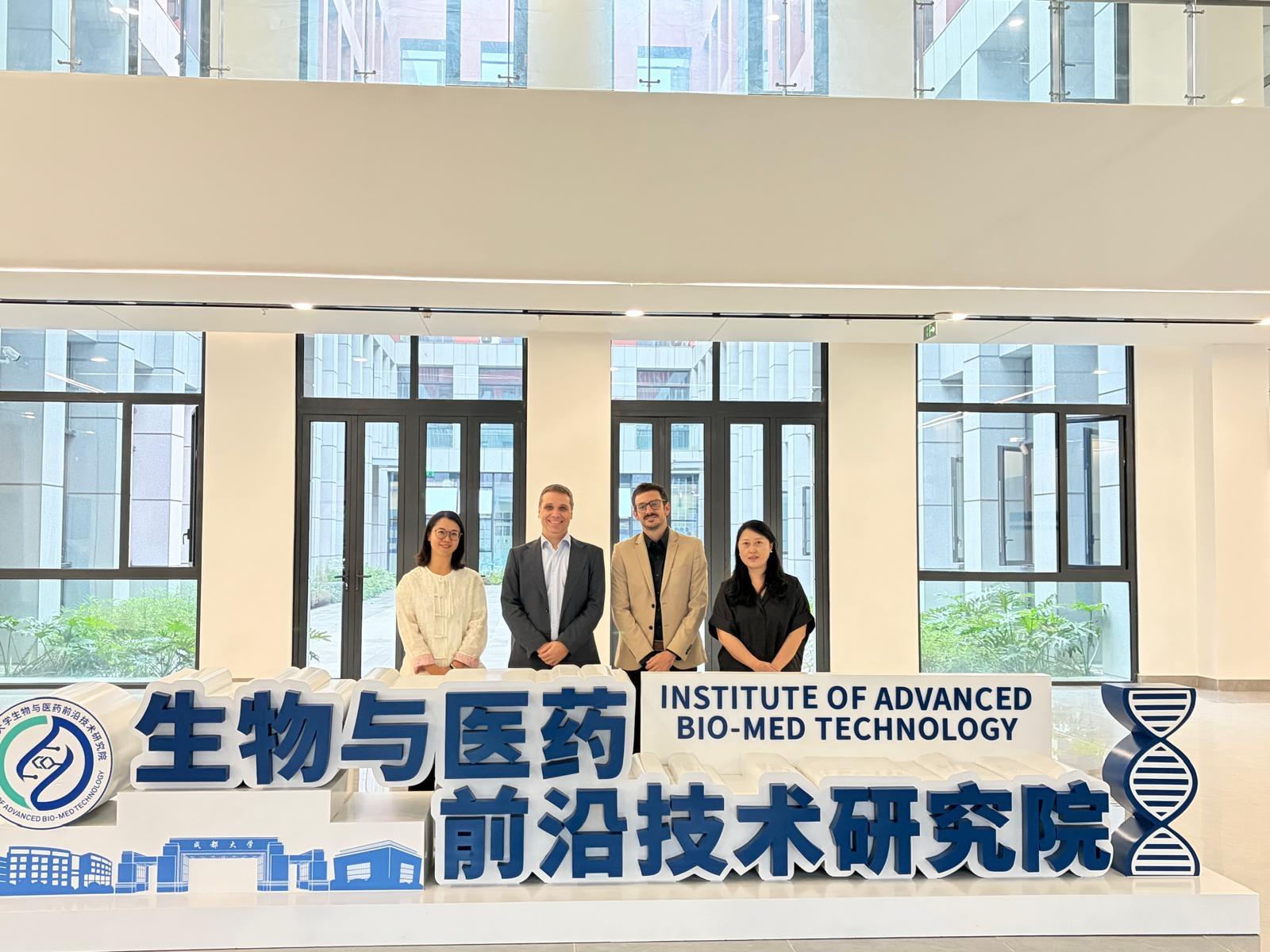
The BETA Technological Center has carried out its first institutional mission to China, visiting Chengdu, the capital of Sichuan province, one of the major agricultural regions in the west of the country. The visit, led by the centre’s director, Sergio Ponsá, and Victor Perelló, head of the Governance for Sustainability team, enabled BETA to establish contacts with leading institutions in applied research, technological innovation and knowledge transfer.
On 20 and 21 October, the delegation visited six Chinese institutions to identify scientific complementarities and explore opportunities for cooperation and joint projects. The mission included public research organisations such as the Chinese Academy of Agricultural Sciences (CAAS) and the Sichuan Academy of Agricultural Sciences (SAAS), as well as Chengdu University and EUPIC, a non-profit foundation specialising in cooperation between Europe and China.
On 22 and 23 October, BETA also took part in a working meeting of the European Erasmus+ Tourism-Zero project at Chengdu University, further expanding its cooperation with Chinese institutions in sustainability and the circular economy.
Sichuan has a scientific and technological ecosystem of particular interest to BETA. The delegation received a very warm welcome from the Chinese institutions, and the visits helped identify possibilities for collaboration with the potential to create new opportunities for the centre and its surrounding territory.
“This first visit to China is an important step for BETA. We have found institutions with strong scientific and technological capabilities and, above all, a clear willingness to collaborate. We want these meetings to be the starting point for future projects and partnerships that will allow us to generate new knowledge and address the challenges facing the agri-food sector and sustainable rural development,” says Sergio Ponsá, director of the BETA Technological Center.
Leading public research in agriculture and the circular bioeconomy
On 20 October, the delegation visited three public research centres with significant activities in agriculture and environmental management.
The first visit was to the Institute of Urban Agriculture of the Chinese Academy of Agricultural Sciences (CAAS) and its vertical farming demonstration base. CAAS is a national agricultural research institution under China’s Ministry of Agriculture and Rural Affairs. Its Institute of Urban Agriculture has advanced facilities for research into controlled-environment agriculture, crop genetic improvement and the application of artificial intelligence in agriculture. It also works on functional agriculture and the circular economy, areas that complement BETA’s research on sustainable food systems.
The second meeting took place at the Institute of Agricultural Resources and Environment of the Sichuan Academy of Agricultural Sciences (SAAS), a public agricultural research organisation in Sichuan province. The institute specialises in the sustainable management of agricultural resources and environmental protection, with research lines covering soil health and fertility, plant nutrition, water-use efficiency and the restoration of degraded ecosystems. Its applied approach offers opportunities to explore collaboration in agricultural sustainability and natural resource management.
The day concluded at the Biogas Institute of the Ministry of Agriculture and Rural Affairs (BIOMA), a public research institute specialising in biogas technologies. Its research on anaerobic digestion, livestock waste valorisation and nutrient recovery aligns with the work of BETA’s Environmental Technologies and Circular Bioeconomy team. This complementarity opens up possibilities for cooperation in the use of organic waste and the development of circular economy solutions.
New opportunities for cooperation with universities and innovation organisations
On 21 October, the delegation continued its visits with three institutions working in international cooperation, environmental engineering and biotechnology innovation.
The first meeting was with EUPIC, a non-profit foundation specialising in cooperation between Europe and China on innovation and technology transfer projects. The organisation has experience in connecting businesses, universities, research centres and public administrations, and works in areas such as the environment, energy and agriculture. The meeting provided an opportunity to explore ways to facilitate BETA’s participation in joint initiatives and identify opportunities for international cooperation.
The delegation then visited the School of Architecture and Civil Engineering at Chengdu University (CDU), which conducts research in environmental engineering, urban sustainability and waste reuse. These areas share common ground with BETA’s work on environmental technologies, waste management and valorisation, and the circular economy.
Finally, the mission included a visit to the Institute of Advanced Bio-Med Technology and the School of Food and Biological Engineering at Chengdu University, where the delegation learned about their applied research activities in food technology, biological engineering, food safety and biomedicine. Their capabilities in developing biological technologies and transferring results to industry offer further possibilities for exploring synergies with BETA.
“We are taking away a very positive impression of the welcome we have received and the opportunities we have identified. Sichuan is a particularly interesting region in which to establish partnerships in sustainable agriculture, circular bioeconomy and environmental management. We now have a great opportunity to turn these initial contacts into lasting collaborations that connect research and innovation with the needs of the territory and create new opportunities for all the institutions involved,” explains Victor Perelló, head of BETA’s Governance for Sustainability team.
BETA takes part in the meeting of the European Erasmus+ Tourism-Zero project in Chengdu
On 22 and 23 October, the BETA Technological Center took part in a working meeting of the European Tourism-Zero project, of which it is a partner, held at Chengdu University. The project promotes sustainability in the tourism sector, with a particular focus on waste prevention and management, the circular economy and innovation in education and training.
Through cooperation between European, Chinese, Thai and Laotian institutions, Tourism-Zero fosters knowledge exchange and promotes practices that help reduce the environmental impact of tourism. The meeting enabled the consortium to advance its joint work and strengthen collaboration with Chengdu University.
BETA’s participation in the project reflects its commitment to applied research and knowledge transfer to develop environmental solutions that can be adopted by productive sectors and contribute to more sustainable economic activity.
A first step towards strengthening international cooperation
The mission enabled BETA to establish direct relationships with public research organisations, universities and cooperation bodies in China, as well as to identify scientific and technological complementarities and explore potential joint projects.
This first visit to Chengdu represents a step forward in the centre’s internationalisation and opens new avenues for engagement with China’s scientific and technological ecosystem. BETA aims to advance towards formal collaboration agreements that facilitate future research and innovation initiatives and knowledge exchange between institutions in both regions.
One of the objectives is to bring innovations and good practices identified during the mission to Catalonia and the rest of Europe, where they could help address shared challenges in sustainability, waste management, agriculture and the circular bioeconomy. At the same time, cooperation with Chinese institutions can foster a two-way exchange of knowledge and experience and the transfer of solutions between the two regions.
