Plastic Pirates returns to Catalonia to continue generating data on plastic pollution in rivers
[addtoany]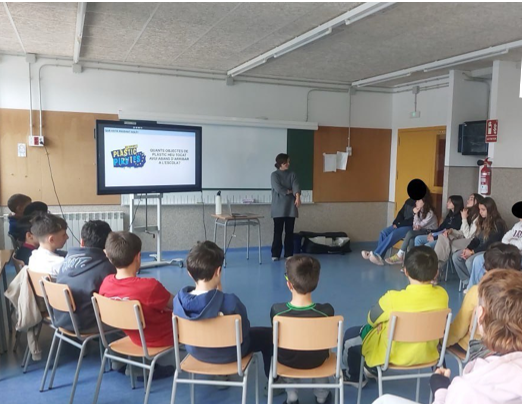
- The project begins a new edition with the challenge of expanding the network of sampling points in Catalan rivers and bringing the project to more schools in Catalonia.
- The new edition will incorporate educational materials and support tools to facilitate sampling and improve the quality and scientific utility of the data collected.
- The project aims to promote a critical look at the structural causes of plastic pollution and possible solutions.
The European citizen science project Plastic Pirates is launching a new edition in Catalonia with the support of the Spanish Foundation for Science and Technology (FECYT). The project involves students and schools in collecting data on the presence of plastic waste in rivers and aquatic environments, and in Catalonia it is coordinated by the BETA Technological Centre of the University of Vic – Central University of Catalonia (UVic-UCC).
This year, Plastic Pirates is launching with 54 schools and a total of 88 student groups who will be sampling different sections of rivers across Catalonia. During September, they expanded their citizen science network, which will allow them to gather more information about an environmental issue that still has significant gaps in our local knowledge.
In this course, students will not only generate data but also observe and reflect on the impact of plastics. The project will also encourage young people’s participation and creativity in imagining solutions and changes that go beyond individual actions.
The data collected during the past academic year demonstrates the potential of this network. Students identified 2,437 pieces of litter, roughly equivalent to one piece of litter per square meter sampled. This data allows for the generation of comparable information on the presence and distribution of litter in riverine areas, contributing to a broader understanding of plastic pollution in Catalan rivers.
From counting waste to understanding the problem
Student participation in the project goes beyond simply collecting and sorting waste. The proposal aims to have young people actively participate in the scientific process: observing their surroundings, formulating questions, generating data, and interpreting it.
This approach allows us to address the problem of plastics from a perspective that goes beyond individual behaviors. Plastic pollution is a complex issue linked to production and consumption patterns, waste management, and the decisions made by various actors in society. This new edition will also provide opportunities to analyze what changes can be promoted by businesses, government agencies, organizations, and society.
Citizen science that thinks about solutions
Plastic Pirates aims to strengthen its educational and participatory dimension. New materials and activities will help participating groups correctly carry out sampling, facilitate data collection, and improve its subsequent use by the BETA scientific teams. Pictograms have been created that summarize the most important steps of each team’s Plastic Pirates protocol and convey the information more visually. Additionally, to improve waste classification, a memory game has been created to help students learn what types of waste can be found in the river.
Young people will be able to propose ideas for reducing plastic waste and contribute to changes in resource and land management. To facilitate this reflection, teachers will have an activity to use in the classroom. Students will have to categorize different measures according to whether they are actions they can implement individually or collectively, and whether they can be carried out at home, at school, or are administrative or municipal in scope.
The project seeks to combine research, environmental education and citizen participation, making the data collected on the ground also serve as a starting point to stimulate the creativity of young people and imagine new solutions.
Plastic Pirates continues to bring scientific research closer to educational centers, with this new edition that expands the network of participants, and turns Catalan rivers into spaces for learning, observation and citizen participation.
