The BETA Technologcal Centre of UVic-UCC joins the CERCA network
The Minister of Research and Universities of the Government of Catalonia, Núria Montserrat, announced the incorporation of the BETA research center into the CERCA system this afternoon
[addtoany]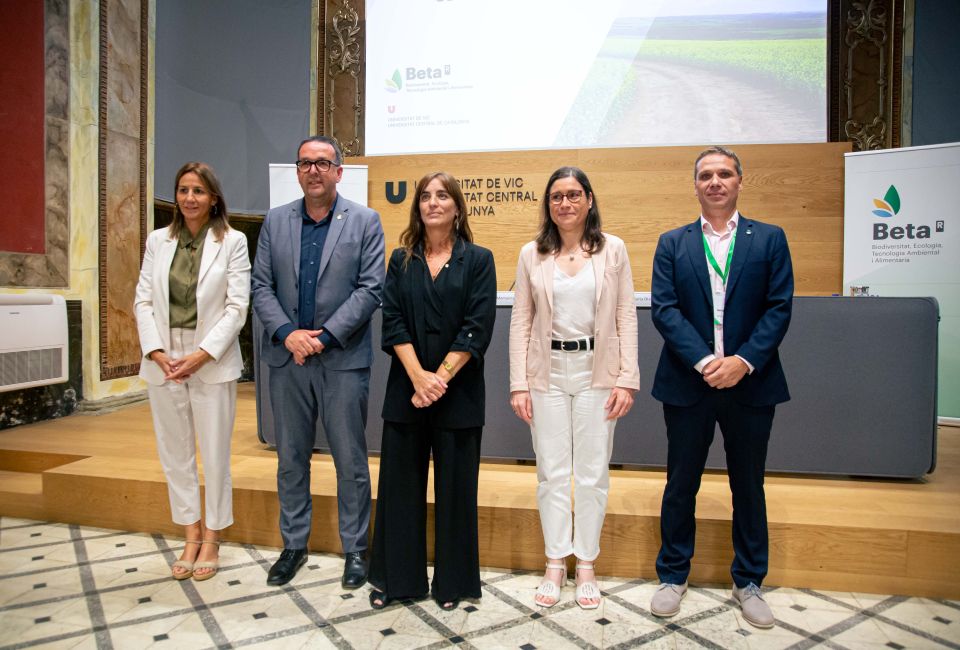
The Technological Center for Biodiversity, Ecology, and Environmental and Food Technology (CT BETA) , affiliated with the University of Vic – Central University of Catalonia (UVic-UCC), officially joins the CERCA system today , Catalonia’s network of research centers of excellence. This inclusion recognizes the center’s trajectory, which, since its founding in 2014, has become a benchmark in key areas such as sustainability, the circular bioeconomy, agri-food systems, and environmental management. This recognition represents a significant milestone, as CT BETA becomes the first CERCA center at UVic-UCC.
The Minister of Research and Universities of the Government of Catalonia, Núria Montserrat, announced the incorporation of the BETA research center into the CERCA system this afternoon at an event held in the Paraninfo of the University of Vic-UCC. Also participating in the event were the Rector of UVic-UCC, Marta Otero; the First Deputy Mayor of Vic, Bet Piella; and the Director of the BETA Research Center, Sergio Ponsá. During her address, the Minister emphasized that “the incorporation of BETA into the CERCA system recognizes a track record of excellence and reinforces a research model closely linked to the local area, capable of transforming knowledge into concrete solutions for the agri-food sector and rural communities.”
Montserrat also highlighted that “with an investment of 800,000 euros, we are equipping the center with new scientific and technological capabilities to accelerate the ecological and digital transition of rural areas. We want research and innovation to reach the entire country and contribute to generating new opportunities, competitiveness, and well-being.”
Rector Marta Otero commented that the integration of CT BETA into the CERCA system “should be understood as recognition of all that has been built and, at the same time, as a commitment to all that we can still build” at UVic-UCC. Speaking from a regional perspective, Otero added that “the recognition of CT BETA as a CERCA center also demonstrates that from Central Catalonia we can generate research of excellence with social impact.”
For her part, Bet Piella highlighted the special significance of this recognition for both the city of Vic and the UVic-UCC. “We have been working for years to consolidate the city’s role as a university town, but also as a city of knowledge, research, and innovation, and BETA is a very clear example of this commitment,” she said. In addition to conducting cutting-edge research from Vic, according to Piella, this center “is capable of projecting the city’s name on a Catalan, European, and international scale.”
Sergio Ponsá extended his gratitude to everyone at CT BETA, including companies, government agencies, institutions, and UVic-UCC, for making this milestone possible. He commented that today was an important day for two main reasons. First, “because we have reached a milestone that was unthinkable years ago; no one would have imagined we would get this far.” Second, because it is a collective project “that goes beyond CT BETA,” the result of growth that “has been neither easy nor linear.”
The director of CT BETA emphasized that joining the CERCA system means recognition, greater visibility, access to more resources, and the opportunity to work with leading centers, but above all, it represents consolidation, since “growing independently has required a tremendous effort.” In this regard, Ponsá stressed that “we don’t want to grow, but to grow better,” so that everyone can achieve higher professional standards, aligned with European benchmarks, and thus generate more value. According to him, “institutional consolidation is a tool for generating greater impact; being part of CERCA doesn’t change our purpose, but rather reinforces it.”
Joining the CERCA network will allow CT BETA to benefit from the support of the CERCA Institution, which acts as a coordinating structure for supporting and strengthening the centers. Within this framework, the center will have access to specialized training for research and management staff, as well as resources and initiatives in strategic areas such as open science, gender equality, knowledge transfer, and internationalization. It will also be able to benefit from transformative agreements that facilitate access to and publication in leading scientific journals.
Joining the CERCA system will help consolidate a more competitive and collaborative research environment, and enhance CT BETA’s capacity to generate knowledge, transfer it to the productive sector and respond to the major environmental and productive challenges of Catalonia, especially those linked to the agri-food sector and rural territories.
An investment to boost innovation in rural areas
The Government, through the Department of Research and Universities, will contribute 800,000 euros to the Technological Center Foundation in Biodiversity, Ecology and Environmental and Food Technology to consolidate an ecosystem of scientific and technological infrastructures of excellence that contributes to accelerating the ecological and digital transition of rural territories.
This contribution will finance the multi-year strategic project “Strategic Infrastructures to Promote Sustainability and Innovation in Rural Areas”, corresponding to the period 2026-2027. The project is structured around four lines of action —environmental genomics, pre-industrial pilot plants, artificial intelligence and soil ecotoxicology—, which will be implemented through the following actions:
- Environmental genomics platform. It will allow the genomic characterization of microorganisms, the monitoring of soil and water biodiversity, and the strengthening of surveillance of pathogens and antimicrobial resistance.
- Pre-industrial innovation space with open and shared pilot plants. It will provide companies and research centers with experimental infrastructures —such as composters, anaerobic digesters, pyrolyzers, vacuum evaporators, photobioreactors or artificial rivers— to validate and scale up new circular bioeconomy technologies before their industrial implementation.
- Digital experimentation and innovation laboratory in bioeconomy. It will allow the development and validation of digital prototypes and artificial intelligence tools applied to sustainability, with the aim of facilitating their subsequent scaling up in supercomputing infrastructures such as the MareNostrum of the Barcelona Supercomputing Center (BSC).
- Soil ecotoxicology analysis laboratory. It will study the biological effects of contaminants on soils and will allow the evaluation of environmental risks from a comprehensive perspective, incorporating the health of ecosystems, animals and people, in accordance with the One Health approach.
This action also falls within the framework of the agreements adopted by the Joint Commission on Economic and Fiscal Affairs between the Spanish central government and the Catalan government. The project is also aligned with the priorities of the RIS3CAT 2030, the Catalan Bioeconomy Strategy 2030 and Catalunya IA 2030, as well as with various European strategic frameworks, including the European Green Deal, the EU Bioeconomy Strategy and the EU Soil Strategy for 2030.
About the BETA Technology Center Foundation
The Technological Center Foundation for Biodiversity, Ecology, and Environmental and Food Technology is headquartered in the Can Baumann Building in Vic. As a technology center, it works to contribute to the competitiveness and environmental sustainability of the productive sector through applied research, the promotion of the bioeconomy, and the transfer of knowledge to companies and public administrations.
Its activities aim to contribute to the sustainable development of society, rural areas, and agri-food systems. To this end, it generates knowledge and develops applicable solutions in areas such as the circular bioeconomy, biodiversity, climate change adaptation, sustainable resource management, and the ecological transition.
One of the key distinguishing features of CT BETA is its commitment to connecting research with the real needs of the region, government bodies, and productive sectors. In this regard, it works closely with businesses, farms, local authorities, and public agencies to transform research results into practical tools, technologies, and management models applicable in the field.